Class E Knowledge Exam: 01 of 03
Free Florida Driving Practice Test 1
Prepare for your Florida Class E knowledge exam (FL driver license written test) with multiple-choice practice questions covering Traffic laws, Safe driving practices and Identifying traffic controls.
STUDY TOPICS
Syllabus Covered
Florida Driver License Handbook.
TEST FORMAT
Question Pool
Multiple-choice practice questions.
YOUR GOAL
Target Pass Mark
Aim for 80% or Higher.
Before You Start the Test:
Read the official Florida Driver License Handbook at least twice, and make sure you know your road signs.
At a railroad crossing, which condition requires a vehicle to stop?
Gate lowered and train visible.
Human flagger warning and gate up.
Warning devices flashing and train visible.
Warning devices flashing and gate lowered.
A driver must stop at a railroad crossing when warning lights are flashing and the gate is lowered, indicating a train is approaching. Proceeding at this time is dangerous and illegal, as the lowered gate signals that the crossing is not safe to enter.
What does this steady yellow traffic light indicate to a driver?
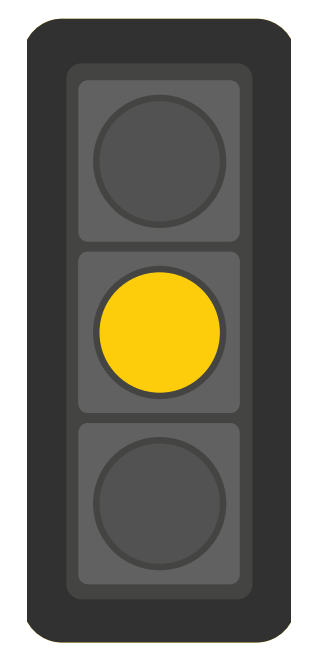
Left turns only permitted.
Light will soon turn green.
Light will soon turn red.
Stop immediately before entering.
A steady yellow traffic light warns drivers that the signal is about to turn red. Drivers should prepare to stop safely unless too close to stop without risk.
When ABS engages in an emergency, which braking action is correct?
Pump the brakes rapidly and repeatedly.
Press down hard and hold the brake pedal.
Release pressure to reengage ABS.
Steer sharply while braking to avoid hazard.
In an emergency with ABS, you should press down hard on the brake pedal and hold it while steering to avoid danger. The ABS system will automatically pump the brakes faster than you could.
Total stopping distance is comprised of which three components?
Braking, hazard recognition, and travel distance.
Perception, speed, and braking distance.
Perception, reaction, and braking distance.
Reaction, acceleration, and stopping distance.
Total stopping distance includes perception distance, reaction distance, and braking distance. Perception involves recognizing the need to stop, reaction is the time it takes to respond, and braking is the distance traveled while braking.
Which group is required to wear safety belts under Florida law?
Children under age 6.
All passengers under the age of 18.
Only drivers and front seat passengers.
Passengers 18 years or older only.
Florida law requires all passengers under 18 to wear safety belts. This rule protects minors from injury in crashes and applies to both front and back seats. Passengers 18 and older are encouraged to buckle up but are not legally mandated under this provision.
What is the fine range for a first DUI conviction?
$1,000 to $2,000.
$2,000 to $5,000.
$100 to $500.
$500 to $1,000.
For a first DUI conviction, the fine range is $500 to $1,000. This is the standard fine, but it can increase to $1,000 to $2,000 if the blood alcohol level (BAL) was 0.15 or higher, or if there was a minor in the vehicle.
Which offense requires completing a Basic Driver Improvement course?
Conviction for running a red light.
Driving with a suspended license.
Exceeding the speed limit by 10 mph.
Failure to maintain liability insurance.
A Basic Driver Improvement (BDI) course is required for a red light violation in Florida. Completing the course helps drivers understand traffic laws, improve driving skills, and prevent future violations.
Which cognitive skill is first affected after drinking an alcoholic beverage?
Attention.
Eyesight.
Judgment.
Reflexes.
Judgment is the first ability impaired after alcohol consumption. Even small amounts reduce decision-making and self-control, causing risky driving behaviors. This early loss of judgment makes it harder to recognize impairment or avoid dangerous situations on the road.
What does this advisory speed sign indicate?
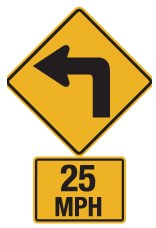
Fastest safe speed for a curve.
Maximum legal speed limit.
Minimum required speed.
Recommended stopping distance.
An advisory speed sign indicates the fastest safe speed for conditions ahead, such as a curve or turn. It helps drivers adjust speed and maintain control for safety.
Which driver behavior best exemplifies a cognitive distraction?
Adjusting the radio controls.
Looking at an object outside the vehicle.
Taking hands off the steering wheel.
Thinking about something other than driving.
A cognitive distraction occurs when a driver’s mind is focused on something other than driving. Thinking about unrelated matters diverts mental attention, reducing awareness, reaction time, and decision-making ability, which increases the risk of collisions.
What is the term used to describe the large blind spots around Commercial Motor Vehicles (CMVs)?
No Zone.
Danger Zone.
Blind Spot.
Safety Zone.
"No Zone" is the term used to describe the large blind spots around Commercial Motor Vehicles (CMVs). These zones are areas where the CMV driver has limited or no visibility.
If a vehicle's speed doubles, how does braking distance change?
Increases by two times.
Increases by nine times.
Remains unchanged.
Increases by four times.
Braking distance rises fourfold when a vehicle’s speed doubles because it is proportional to the square of speed. Higher speeds exponentially increase the distance needed to stop, making speeding extremely dangerous and reducing reaction time to avoid collisions.
Which document proves residential address in Florida for a driver license?
Marriage certificate.
Social Security card.
Vehicle registration or title.
US passport or passport card.
A vehicle registration or title is accepted as proof of residential address in Florida for a driver's license. This is because it directly links an individual to a specific address through an official state record.
Maintaining a safe following distance is important primarily to:
Help the vehicle ahead see you better.
Make passing other vehicles easier.
Provide time to react and avoid collisions.
Reduce chance of being pulled over.
Maintaining a safe following distance provides you with adequate time to react to unexpected situations and avoid potential collisions by increasing the space between your vehicle and the vehicle in front of you.
Low-speed vehicles (LSVs) are permitted to operate on streets with a posted speed limit of:
Posted 35 MPH or less.
Posted 45 MPH or less.
Posted 25 MPH or less.
Posted 15 MPH or less.
Low-speed vehicles (LSVs) are allowed only on streets with a posted speed limit of 35 MPH or less. This restriction ensures safety because LSVs have limited speed and are less capable of keeping up with faster traffic on higher-speed roads.
What is the restriction code for 'Daylight Driving Only'?
F.
G.
H.
I.
Restriction code ‘G’ means ‘Daylight Driving Only’, allowing the driver to operate a vehicle only during daylight hours. This restriction is usually applied for drivers with limited vision or medical conditions affecting night driving safety.
Which vehicle type does a Florida Class E license permit?
Non-commercial vehicles under 26,001 lb GVWR.
Motorcycles over 50 cc engine displacement.
Commercial vehicles over 26,001 lb GVWR.
Vehicles carrying 16 or more passengers.
A Florida Class E license allows drivers to operate noncommercial vehicles with a Gross Vehicle Weight Rating (GVWR) under 26,001 pounds. It covers most personal cars, small trucks, and SUVs but excludes large commercial vehicles or motorcycles over 50cc.
When parking uphill without a curb, you should turn your wheels:
Away from curb.
To the left.
Toward curb.
To the right.
When parking uphill without a curb, you should turn your wheels to the right. This will ensure that if the vehicle starts to roll, it will move away from the traffic lane.
What does this sign signify?
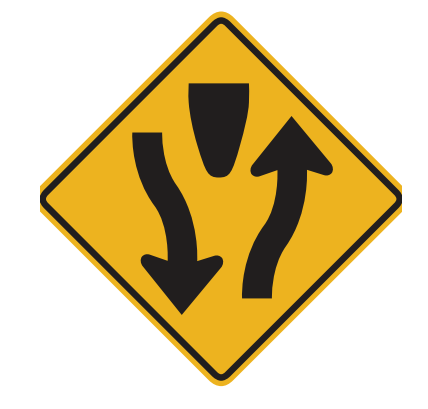
Highway will merge into one lane.
Highway divided by a median.
Highway has sharp curves.
Highway will end shortly.
The 'Divided Highway Ahead' sign indicates that the road ahead is split into two separate roadways by a median or divider. This separation reduces the risk of head-on collisions.
Which distraction categories does texting while driving involve?
Manual cognitive only.
Only cognitive distraction.
Visual manual only.
Visual manual cognitive.
Texting while driving is dangerous because it involves visual distraction (taking eyes off the road), manual distraction (taking hands off the wheel), and cognitive distraction (thinking about the text instead of driving).
What does this sign indicate drivers should do?
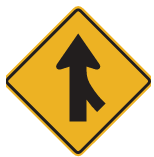
Increase speed to merge quickly.
Watch for traffic and yield.
Signal and change lanes.
Stop and wait for a gap.
The Merging Traffic sign indicates that drivers should watch for traffic and be prepared to yield to ensure a safe merge. This means assessing the speed and position of vehicles already on the roadway and adjusting your speed or stopping if necessary to merge without causing a collision.
What type of sign is this?
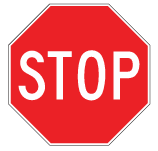
Regulatory sign.
Warning sign.
Guide sign.
Information sign.
A stop sign is a regulatory sign, which instructs drivers to take a specific action — in this case, to come to a complete stop. It is legally enforceable and ensures safe and orderly traffic flow at intersections.
Select the two main causes of drowsy driving:
Lack of sleep and driving at normal sleep times.
Driving at night and driving long distances.
Poor visibility and driver fatigue.
Stress and prolonged lack of attention.
The two major causes of drowsy driving are lack of sleep and driving when you would normally be sleeping. Drowsy driving is dangerous because it slows thought processes and reaction time.
Which violation is associated with 3 points on a driving record?
Driving during restricted hours.
Texting while driving.
Reckless driving violation.
Passing a stopped school bus.
Texting while driving adds 3 points to a Florida driving record. This offense is considered a serious distraction that increases the risk of accidents. Accumulating points can lead to higher insurance rates, fines, or license suspension if multiple violations occur.
What does a single solid white line on the roadway signify?
Indicates a passing zone on the roadway.
Marks the left edge of the roadway.
Marks the right edge of the roadway.
Separates lanes moving in the same direction.
A single solid white line along the roadway indicates the right edge of the road. It guides drivers, especially at night or in poor visibility, helping them stay within the driving lane and avoid leaving the roadway.