Class C Knowledge Exam: 01 of 05
Free Texas DPS Driving Practice Test 1
Prepare for your Texas DPS Class C knowledge exam (TX driver license written test) with multiple-choice practice questions covering rules of the road, road signs and signals and safe driving practices.
STUDY TOPICS
Syllabus Covered
Texas Driver Handbook.
TEST FORMAT
Question Pool
Multiple-choice practice questions.
YOUR GOAL
Target Pass Mark
Aim for 70% or Higher.
Before You Start the Test:
Read the official Texas Driver Handbook at least twice, and make sure you know your road signs.
When should you slow down and increase following distance?
Clear visibility.
Light traffic.
Wet roads.
Dry roads.
Wet roads reduce tire traction and increase stopping distance, making skids more likely. Slowing down and increasing your following distance gives you more time to react and helps prevent collisions when road surfaces are slippery due to rain or moisture.
Most motor vehicles in Texas must have how many working brake lights?
Four.
Two.
Three.
One.
Most motor vehicles in Texas are required to have two working brake lights. This ensures vehicles behind can clearly see when the driver is braking, thus preventing accidents.
The principle ‘right-of-way is given, not taken’ means what?
It is automatically guaranteed to you.
Larger vehicles always have it.
Other drivers must grant it to you.
The faster vehicle always has it.
“Right-of-way is given, not taken” means you should never assume you automatically have priority. Even if rules favor you, you must wait until other drivers yield. This prevents collisions caused by assuming others will stop or allow you to proceed.
In a modern roundabout, traffic flows in which direction?
Alternating directions.
Clockwise around a center island.
Clockwise around the perimeter.
Counter-clockwise around a center island.
Modern roundabouts are designed for vehicles to travel counter-clockwise around a central island. This layout reduces conflict points, lowers crash severity, and keeps traffic moving smoothly compared to traditional intersections, improving overall safety and efficiency.
You must stop for a school bus when its what is activated?
Bus is on a residential street.
Bus is at an intersection.
Children are present.
Red lights are flashing.
When a school bus displays alternately flashing red lights, you are required to stop your vehicle. Do not proceed until the bus has resumed motion, you are signaled by the driver to proceed, or the red lights are no longer flashing.
If your car begins to skid, which action should you avoid?
Hitting the brakes suddenly and hard.
Accelerating to regain control.
Applying the brakes firmly.
Steering straight ahead.
Braking suddenly causes wheel lockup, reducing traction and worsening the skid. Maintaining calm control, easing off pedals, and steering smoothly helps regain stability. Sudden hard braking removes steering ability and increases the risk of spinning or losing full control of the vehicle.
Failing to stop after a crash that causes a death is classified as what?
A Class C misdemeanor.
A Class B misdemeanor.
A third degree felony.
A second degree felony.
Failing to stop after a crash that results in a death is a serious offense classified as a second-degree felony. Penalties include up to a $10,000 fine and 2–20 years in prison, reflecting the severe legal consequences of leaving such a crash scene.
When an emergency vehicle approaches, what should you do?
Continue at the same speed.
Pull to the right edge of the road and stop.
Speed up to get out of the way.
Stop in the middle of the road.
When an emergency vehicle approaches with sirens or flashing lights, you should pull to the right side of the road and stop to allow them to pass safely. This ensures they can reach their destination without obstruction.
Which scenario best describes a collision?
Two vehicles colliding into each other.
A vehicle swerving to avoid an object.
A vehicle parked illegally.
A near miss with another vehicle.
A collision occurs when two or more objects physically strike each other. Near misses or swerving do not count because no impact happens. When two vehicles hit each other, it meets the exact definition of a collision under traffic safety guidelines.
What does signaling mainly tell other drivers?
The type of vehicle you are driving.
Your intention to turn or stop.
Your current speed and acceleration.
The route you intend to take.
Using signals shows other drivers that you plan to turn, change lanes, or stop. This communication helps them predict your next move, adjust their speed or position, and maintain safe spacing, reducing the chances of sudden conflicts or collisions on the road.
Under the Zero Tolerance Law, who is considered a minor for alcohol offenses?
Under 18 years of age.
Under 19 years of age.
Under 20 years of age.
Under 21 years of age.
The Zero Tolerance Law makes it illegal for anyone under 21 to buy, possess, or consume alcohol. Even a small amount violates the law. This rule helps reduce underage drinking and improves safety on roads and in communities.
How should drivers respond to regulatory traffic signs?
Ignoring them if traffic is light.
Obeying them as traffic laws.
Obeying them only during rush hour.
Treating them as suggestions.
Regulatory signs carry legal authority and must be followed exactly as written. They guide speed, movement, lane use, and restrictions to maintain safe and orderly traffic. Ignoring these signs increases crash risk and violates Texas traffic laws.
What is the penalty for a first offense of driving without insurance?
A fine of $50 to $100.
A fine of $175 to $350.
Community service.
Suspension of driver license.
For a first conviction of driving without financial responsibility in Texas, the law imposes a fine between $175 and $350. This penalty encourages drivers to maintain valid insurance coverage and ensures financial accountability in case of crashes.
What does this sign signify?
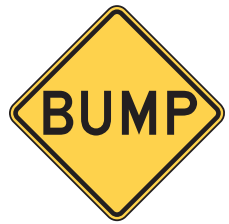
Sudden road narrowing ahead.
Steep incline begins.
Sudden high place ahead.
Road surface lifts unevenly.
The sign warns drivers of a sudden raised section on the road. Reducing speed helps maintain control and prevents discomfort or damage when crossing the high point.
What is the main purpose of cargo-transport regulations?
Increase fuel efficiency.
Prevent loose material from escaping.
Improve the vehicle's appearance.
Reduce wind resistance.
Cargo-transport rules ensure loose materials are secured so nothing falls onto the roadway. Escaping cargo can strike other vehicles, block lanes, or cause drivers to swerve, creating major safety hazards. Properly contained loads reduce accidents and protect all road users.
At night, bicycles are required to have which equipment?
A bell and pedal reflectors.
A bright headlight and taillight.
Front lamp and rear reflector.
Reflective tires and a horn.
For nighttime bicycle use, the law requires a white front lamp visible from 500 feet and a red rear reflector visible from 50 to 300 feet. A red light on the rear visible from 500 feet may be used IN ADDITION to the red reflector.
Parking, stopping, or standing is prohibited where?
In a private driveway with permission.
More than 18 inches from the curb.
On a sidewalk.
With the vehicle facing against traffic.
Parking or stopping on a sidewalk blocks pedestrian movement and violates Texas parking rules. Sidewalks are reserved for people walking, including children and individuals with disabilities, so vehicles are strictly prohibited from using or obstructing these areas at any time.
What does this sign indicate?
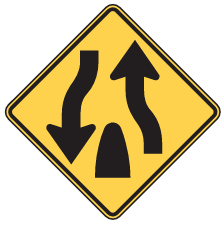
Divided highway ends.
One-way traffic ahead.
Four-lane highway ahead.
Divided highway ahead.
This sign warns that the physical divider between traffic lanes is ending. Drivers must be alert because two-way traffic begins again, requiring extra caution to avoid oncoming vehicles.
What is the main safety purpose of one-way street signs?
Preventing head-on collisions.
Improving traffic flow.
Regulating parking.
Simplifying driver navigation.
One-way street signs ensure all vehicles travel in the same direction, eliminating the risk of head-on collisions. If the sign faces you, it means you are going the wrong way and directly against traffic flow, creating a dangerous situation for all drivers.
Which person is NOT exempt from safety-belt laws?
A postal worker delivering mail.
A utility worker repairing power lines.
A solid-waste truck worker collecting trash.
A tourist visiting from another state.
Texas law does not provide exemptions for tourists. Some workers, such as postal or utility employees, may have defenses to prosecution while performing specific duties, but tourists must follow all safety-belt requirements without exception to ensure personal safety.
What does this sign mean?

Hospital ahead.
Double T-Junction ahead.
Cross road ahead.
Railway crossing ahead.
This warning sign indicates a crossroad where another road meets from both left and right. Drivers should slow down, check all directions and proceed cautiously to avoid collisions.
Individuals under 25 must complete which required course?
A defensive driving course.
A driver safety course.
An advanced driving course.
An approved driver education course.
Texas law (Less Tears More Years Act) requires all driver-license applicants under 25 to complete an approved driver education course. This ensures young drivers receive proper training, understand traffic laws, and develop safe driving habits before obtaining their license.
What is the only effective way to reduce alcohol’s effects?
Time.
Exercising vigorously.
Taking a cold shower.
Drinking black coffee.
Only time allows the body to process and eliminate alcohol. Coffee, cold showers, or exercise cannot speed this process. The body typically needs about one hour to clear the alcohol from a single drink, making time the only reliable method.
If a sidewalk exists, walking in the street is considered what?
Unsafe, violating sidewalk rules.
Safe, if not under the influence.
Safe, if looking both ways.
Safe, if walking on the left side.
When sidewalks are available, pedestrians must use them. Walking in the street increases collision risk because drivers may not expect someone in the roadway. Using the sidewalk keeps pedestrians separated from traffic and supports essential safety guidelines.
Defensive driving relies on using what?
Predictive braking system.
Speed control technique.
Space management system.
Vehicle size assessment.
Defensive driving depends on maintaining safe space around your vehicle. A space management system helps drivers anticipate hazards, keep a proper buffer, and react safely to sudden changes. This reduces collision risk and improves overall road awareness and control.