Learner Permit Test: 01 of 05
Free New Jersey Driving Practice Test 1
Prepare for your New Jersey MVC driving knowledge test (NJ permit written test) with multiple-choice practice questions covering traffic laws, road signs and safe driving rules.
STUDY TOPICS
Syllabus Covered
New Jersey Driver Manual.
TEST FORMAT
Question Pool
Multiple-choice practice questions.
YOUR GOAL
Target Pass Mark
Aim for 80% or Higher.
Before You Start the Test:
Read the official New Jersey Driver Manual at least twice, and make sure you know your road signs.
What is a ‘no-zone’ regarding large trucks and buses?
A loading zone.
A parking zone.
A speed zone.
A blind spot.
A no-zone is a blind spot where a truck or bus driver cannot see other vehicles, making it dangerous to drive in those areas.
Seat belt and shoulder strap use improves survival chances by:
2 times.
3 to 4 times.
5 times.
6 times.
Wearing both a seat belt and shoulder strap increases survival chances by three to four times during a crash.
What is the maximum speed a moped is permitted to travel?
25 mph.
20 mph.
15 mph.
35 mph.
Motorized bicycles, or mopeds, are only allowed to travel at a maximum speed of 25 mph on public roads.
In New Jersey, driving is considered a:
Constitutional Right.
Requirement.
Privilege.
Mandatory duty.
Driving is a privilege, not a right. The State of New Jersey can revoke this privilege if a motorist violates laws.
The ‘three-second-plus rule’ is used for:
Determining speed limits.
Measuring engine warm-up.
Measuring vehicle length.
Judging following distance.
The three-second-plus rule helps motorists determine a safe following distance between their vehicle and the one in front.
Where is the red light located on a vertical traffic signal?
At the bottom.
In the middle.
At the top.
Next to the green light.
In a vertical signal, the red light is always at the top, followed by yellow in the middle, and green at the bottom.
What is the required height for license plates?
12 to 48 inches.
10 to 36 inches.
15 to 45 inches.
20 to 50 inches.
License plates must be at least 12 inches but no more than 48 inches above the ground.
What should you do with your toes while riding?
Rest them on the engine.
Point them downward.
Dangle them near the ground.
Keep them pointed up.
Toes should be pointed up to prevent them from getting caught between the road and the footrest.
What does this sign mean?
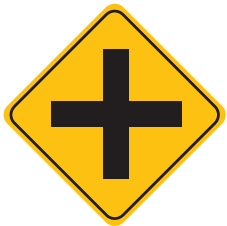
Hospital ahead.
Crossroad ahead.
Double T-Junction ahead.
Railway crossing ahead.
This sign warns you that another road crosses the main highway ahead. You should be alert and look in all directions for traffic.
What is an uncontrolled intersection?
One with no signals.
One with many lanes.
One with one lane.
A highway exit.
An intersection is uncontrolled when two or more roads join and there is no traffic signal or regulatory device.
What does the Safe Corridors law do?
Doubles fines for offenses.
Adds more toll booths.
Decreases speed limits.
Closes highways at night.
The Safe Corridors law doubles fines on various state highways for speeding and aggressive driving.
Motorists qualify for the Mature Driver Program at the age of:
50 years or older.
55 years or older.
62 years or older.
65 years or older.
The Mature Driver Program is a defensive driving course available to motorists who are 55 years of age or older.
The speed limit in a New Jersey school zone is:
10 mph.
35 mph.
50 mph.
25 mph.
New Jersey law sets a 25 mph speed limit for school zones, business, or residential districts.
What does this sign indicate?
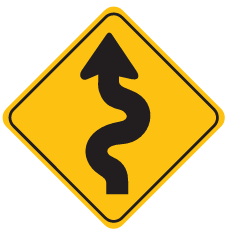
Slippery road ahead.
Winding road ahead.
Curved road ahead.
First right then left ahead.
This sign warns of a winding road with three or more curves in a row. You should slow down and drive carefully.
What is the minimum required tire tread depth?
1/8 inch.
1/32 inch.
1/16 inch.
1/4 inch.
A vehicle should not be driven with tires that have less than 1/16 inch of tread (about the edge of a penny).
Children under age 8 must use a booster seat if their height is:
Less than 45 inches.
Less than 50 inches.
Less than 62 inches.
Less than 57 inches.
Children under age eight who are less than 57 inches tall must ride in a federally approved restraint system or booster seat.
What does this sign represent?
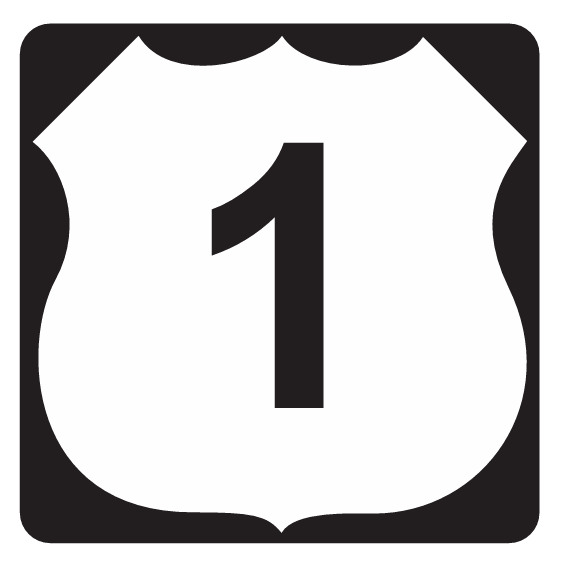
State route marker.
U.S. route marker.
Interstate route marker.
County route marker.
This shield-shaped sign identifies a U.S. Route. It is distinct from the blue-and-red Interstate signs and the square or circular signs often used for State or County routes.
What is the primary danger of tailgating?
It improves fuel efficiency.
It helps traffic flow.
It increases rear-end crash risk.
It decreases rear-end crash risk.
Tailgating reduces reaction time, making it difficult to avoid a collision if the vehicle in front stops suddenly.
What is the primary message of a ‘Wrong Way’ sign?
Against the flow of traffic.
The road ahead is closed.
You missed your exit.
The lane is for HOV only.
A 'Wrong Way' sign means you are driving in the opposite direction of traffic and must turn around immediately.
A crosswalk that exists at an intersection but is not marked is called:
A ghost crosswalk.
An unmarked crosswalk.
An invisible crosswalk.
A legal crosswalk.
Even if there are no painted lines, a crosswalk exists at every intersection. This is legally known as an "unmarked crosswalk."
When is a motorcycle permit holder prohibited from riding?
On weekends.
In residential areas.
30 mins after sunset.
30 mins before sunset.
Motorcycle permit holders are prohibited from operating a motorcycle from sunset to sunrise (after dark).
The ‘Implied Consent Law’ means:
You agree to take a breath test.
You agree to pay all tolls.
You agree to follow speed limits.
You agree to carry insurance.
By using NJ roadways, motorists automatically agree to submit to a breath test if suspected of a drinking-and-driving offense.
Hydroplaning typically starts at a speed of:
25 mph.
45 mph.
35 mph.
55 mph.
Hydroplaning can start at speeds as low as 35 mph, causing tires to lose contact with the wet road surface.
If a motorist’s BAC reaches 0.05 percent, the risk of a crash:
Doubles.
Triples.
Stays the same.
Quadruples.
Reaching a Blood Alcohol Concentration (BAC) of 0.05 percent doubles the risk of being involved in a motor vehicle accident.
How does marijuana use affect a motorist’s driving?
Slows reaction time.
Has no effect.
Increases alertness.
Loss of tracking ability.
Marijuana affects a motorist by causing a loss of tracking ability, distance judgment, and vigilance.