Learner Permit Test: 02 of 05
Free New Jersey Driving Practice Test 2
Prepare for your New Jersey MVC driving knowledge test (NJ permit written test) with multiple-choice practice questions covering traffic laws, road signs and safe driving rules.
STUDY TOPICS
Syllabus Covered
New Jersey Driver Manual.
TEST FORMAT
Question Pool
Multiple-choice practice questions.
YOUR GOAL
Target Pass Mark
Aim for 80% or Higher.
Before You Start the Test:
Read the official New Jersey Driver Manual at least twice, and make sure you know your road signs.
What is the shape and color of a warning sign?
Red octagon.
Blue square.
White rectangle.
Yellow diamond.
Most warning signs are yellow and diamond-shaped with black symbols or letters.
Which is a sign of aggressive driving?
Failing to yield the right of way.
Yielding the right of way.
Making proper lane changes.
Using turn signals in advance.
Aggressive driving includes behavior like failing to yield, which endangers other motorists.
At 40 mph, the pedestrian fatality rate is:
5 percent.
25 percent.
85 percent.
50 percent.
The fatality rate for pedestrians jumps to 85 percent when hit by a vehicle traveling at 40 mph.
From what distance must the rear license plate be visible?
25 feet.
50 feet.
75 feet.
100 feet.
The rear license plate must be lighted so it is clearly visible from 50 feet at night.
What is the crash-prevention formula?
Brake hard, turn fast, stay alert.
Speed up, stay left, use horn.
Be alert, be prepared, act in time.
Watch mirrors, signal, slow down.
This formula helps motorists reduce the risk of accidents by staying focused and ready to react.
An interlock device prevents starting a car if the BAC exceeds:
0.01%.
0.05%.
0.08%.
0.10%.
An Ignition Interlock Device has a built-in breathalyzer that stops the car if the motorist's BAC is 0.05% or higher.
What percentage of alcohol is oxidized by the liver?
10%.
50%.
75%.
90%.
About 90 percent of the alcohol detoxified is oxidized (burned up) by the liver.
Seat belts improve chances of surviving a crash by:
40 percent.
60 percent.
70 percent.
50 percent.
Wearing a seat belt increases a motorist's chance of surviving a crash by 60 percent.
At 20 mph, a motorist should be able to stop within:
25 feet.
15 feet.
35 feet.
50 feet.
A vehicle traveling at 20 mph should be able to come to a complete stop within 25 feet.
What does this sign represent?
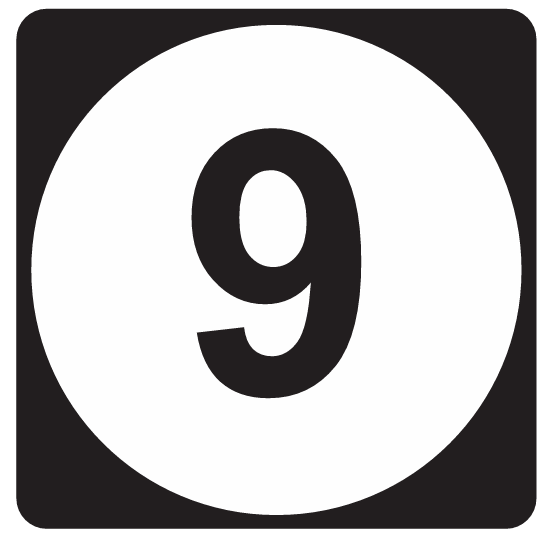
U.S. route marker.
Interstate route marker.
County route marker.
State route marker.
In New Jersey, a square black sign with a white circle and a number indicates a State Route.
At what speed do air bags inflate?
Up to 50 mph.
Up to 100 mph.
Up to 200 mph.
Up to 300 mph.
Air bags inflate at speeds up to 200 mph to instantly protect adults during a front-end collision.
What is the purpose of the OIFP?
Issue licenses.
Register cars.
Investigate fraud.
Set speed limits.
The Office of the Insurance Fraud Prosecutor (OIFP) investigates and prosecutes insurance fraud cases.
A habitual offender is a motorist whose license has been suspended:
Two times in two years.
Three times in three years.
Four times in four years.
Five times in five years.
A habitual offender is defined as a motorist whose driver license has been suspended three times in a three-year period.
What is prohibited for a motorcycle permit holder?
Riding on a highway.
Riding without a reflective jacket.
Riding after dark.
Carrying passengers.
In New Jersey, the most strictly enforced prohibition for a motorcycle examination permit holder is carrying any passengers.
On a horizontal traffic signal, where is the red light?
Above the arrow.
On the far left.
On the far right.
In the center.
When traffic lights are horizontal, the red light is always on the left, followed by yellow and green.
What does this sign mean?
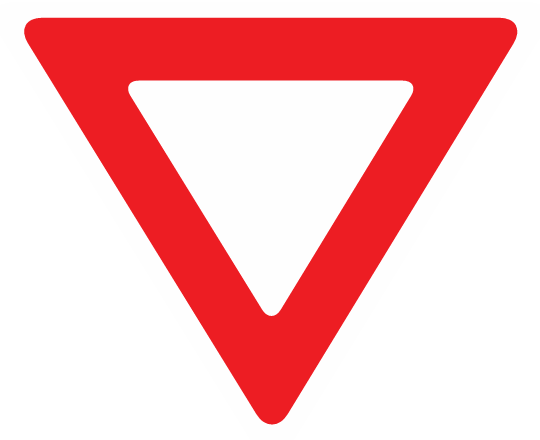
Stop.
Yield.
No Entry.
Speed Limit.
A red and white inverted triangle is a yield sign, which means you must slow down and give the right of way to other traffic.
What is the speed limit on non-posted rural roadways?
40 mph.
45 mph.
50 mph.
60 mph.
In New Jersey, the speed limit on non-posted rural roadways is 50 mph unless otherwise indicated.
When are road surfaces most slippery?
First few minutes of rainfall.
During a light frost.
After a long heavy rain.
During a heavy snowstorm.
Road surfaces are most slippery during the first few minutes of a rainfall as the rain mixes with oil and dust.
At what age can someone operate a motorized scooter?
10 years old.
12 years old.
16 years old.
17 years old.
No one under the age of 12 is permitted to operate a motorized scooter unless otherwise determined by local law.
Where is passing on the right strictly prohibited?
Multi-lane highways.
Right shoulder of the road.
Roads with two lines.
One-way streets.
Passing on the right shoulder of the road is never allowed and is strictly against the law.
What does this sign indicate?

No passing zone ahead.
Hospital ahead.
Double crossroads ahead.
Railroad crossing ahead.
This yellow circular sign with a black 'X' and 'RR' warns motorists that they are approaching a railroad crossing.
What is the speed limit for a Low-Speed Vehicle (LSV)?
Under 15 mph.
20 to 25 mph.
Exactly 30 mph.
Up to 35 mph.
An LSV is a four-wheeled vehicle with an attainable speed of more than 20 mph, but no more than 25 mph.
What is the only thing that can make a person sober?
Fresh air.
Cold showers.
Time.
Drinking black coffee.
Only time can sober up a person by allowing the body to process and eliminate alcohol.
When both center lines are solid, what is the rule?
Pass only during the day.
Pass only if safe.
Passing is allowed.
No passing allowed.
Solid double lines mean that passing is prohibited for motorists traveling in both directions.
Under 21 motorists are penalized with a BAC of at least:
0.01%.
0.05%.
0.08%.
0.10%.
New Jersey has a zero-tolerance policy for motorists under 21, penalizing any BAC of 0.01% or higher.