Class C Knowledge Exam: 04 of 05
Free Texas DPS Driving Practice Test 4
Prepare for your Texas DPS Class C knowledge exam (TX driver license written test) with multiple-choice practice questions covering rules of the road, road signs and signals and safe driving practices.
STUDY TOPICS
Syllabus Covered
Texas Driver Handbook.
TEST FORMAT
Question Pool
Multiple-choice practice questions.
YOUR GOAL
Target Pass Mark
Aim for 70% or Higher.
Before You Start the Test:
Read the official Texas Driver Handbook at least twice, and make sure you know your road signs.
On a three-lane one-way road with broken white lines, which lane can a driver use?
Any lane.
Only the right lane.
Only the left lane.
Only the center lane.
On a one-way three-lane road, broken white lines allow drivers to use any lane and change lanes safely. This helps maintain traffic flow while permitting flexibility in lane choice.
What does this sign mean?

Bridge narrower than the road ahead.
Bridge wider than the road ahead.
Bridge under construction ahead.
Bridge closed ahead temporarily.
This sign warns drivers that the upcoming bridge is narrower than the approaching road. Slowing down and exercising caution ensures safe passage, prevents collisions, and allows proper vehicle positioning while crossing.
Who MUST be secured in a federally approved child car seat?
A 9-year-old who is 4'10"
A 16-year-old who is 5'5"
A 7-year-old who is 4'8"
A 17-year-old who is 6'0"
Texas law requires any child under 8 years old and shorter than 4'9" to ride in a federally approved child car seat. A 7-year-old who is 4'8" meets both legal conditions, making a car seat mandatory for safety and compliance.
When must a driver yield to a pedestrian?
When the pedestrian has a WALK signal.
Only when turning right.
Only when going straight.
Only when turning left.
Drivers must yield to pedestrians with a WALK signal to ensure their safety while crossing. This rule protects pedestrians and prevents accidents at intersections and crosswalks.
What is true about drug effects on individuals?
Effects are uniform across individuals.
Effects can vary from person to person.
Only the type of drug matters.
Only the time of day matters.
Drug effects vary because factors such as body weight, emotional state, and the amount of drug taken can influence how a person responds to a drug. The same drug can affect different people in different ways.
Recommended following distance for beginning drivers:
Four-second interval.
Adjusted only by vehicle type.
Shorter distance when driving faster.
Two-second interval.
A four-second following interval is recommended for beginning drivers because it gives them more time to react to unexpected situations, especially since it takes the average person 1.5 seconds to react and apply the brakes.
At a T-intersection, which vehicle has the right-of-way?
Vehicle on the left.
Vehicle that arrives first.
Vehicle with a larger engine.
Vehicle on the through street.
At a T-intersection, vehicles on the through street have the right-of-way. Approaching vehicles must yield, ensuring safe merging and preventing collisions at the junction.
After a crash, what must be written exactly as on the proof-of-insurance card?
Insurance policy number.
Driver license information.
Names and addresses.
Vehicle license plate number.
After a crash, the insurance policy number must be recorded exactly as it appears on the proof-of-insurance card. This ensures accurate documentation, verification of coverage, and proper processing of any claims or legal requirements.
Minimum liability insurance in Texas for property damage:
$10,000.00
$20,000.00
$30,000.00
$25,000.00
Texas law requires at least $25,000 liability insurance for property damage. This protects drivers from financial loss in accidents and ensures coverage for damages caused to others.
Minimum legal tread depth for passenger car tires in Texas:
1/32 of an inch.
2/32 of an inch.
3/32 of an inch.
4/32 of an inch.
The minimum legal tread depth for passenger car tires in Texas is 2/32 of an inch. This ensures proper grip, handling, and safe driving under all normal road and traffic conditions.
What does this sign indicate?
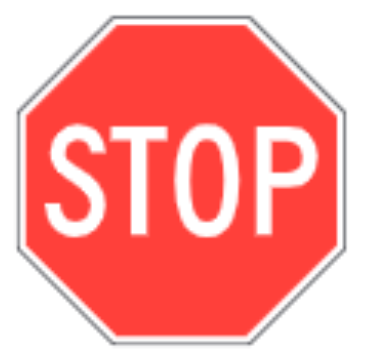
Slow down and proceed with caution.
Stop only if pedestrians are present.
Come to a complete stop and yield.
Reduce speed, no need to stop.
A stop sign requires each vehicle to come to a full stop before the crosswalk, intersection, or stop line. Drivers must yield to pedestrians and other vehicles, ensuring safe and controlled passage. Slowing down is not enough.
During a driving exam, what does "Observation" mean?
Reacting quickly to hazards.
Predicting other drivers’ actions.
Using mirrors effectively.
Seeing what other traffic is doing.
Observation in a driving exam measures your awareness of surrounding traffic and hazards. It involves actively monitoring vehicles, pedestrians, and road conditions to make safe, informed driving decisions.
Safest action when passing if in another driver’s blind spot?
Honk to alert the other driver.
Maintain the same speed.
Move closer to the other vehicle.
Slow down or complete the pass.
The safest action when in another driver's blind spot while passing is to either speed up to complete the pass quickly or slow down to drop back out of the blind spot. This minimizes the time spent in a dangerous, unseen area.
what is the first action when stopped by law enforcement?
Speed up to a safe location.
Stop immediately in the lane.
Slow down and move safely to the right.
Turn on your high beams.
The first step when stopped by law enforcement is to slow down and safely move to the right. This ensures your safety and allows a controlled, lawful interaction with the officer.
One of the first effects of alcohol or drug use on driving:
Heightened emotional state.
Loss of judgment and impaired sight.
Improved coordination.
Increased reaction time.
Alcohol and drug use primarily affect judgment and vision, which are critical for safe driving. Impaired judgment can lead to poor decision-making, such as speeding or tailgating, while impaired vision reduces the ability to see and react to hazards on the road. 🚗 😵💫
What is the Effect of turbulence between two large vehicles?
Causes vehicles to spin.
Has no effect.
Pulls vehicles together.
Pushes vehicles apart.
Turbulence created by large vehicles causes a low-pressure zone. The higher pressure surrounding the vehicles pushes them away from each other. Imagine two boats 🛥️🛥️ passing closely; they tend to be pushed away rather than pulled together.
Why is signaling important in defensive driving?
Helps avoid getting stuck in traffic.
Maintains smooth traffic flow.
Mandatory by law.
Alerts others to your actions.
Signaling is a crucial aspect of defensive driving because it communicates your intentions to other drivers. This communication helps prevent accidents by giving others time to anticipate and react to your actions.
Most frequent cause of car-motorcycle crashes at intersections?
Car turning left in front of oncoming motorcycle.
Cars having the right-of-way.
Motorcycles speeding through intersections.
Motorcycles being difficult to steer.
The most frequent cause of car-motorcycle crashes at intersections happens when a car turns left directly in front of an oncoming motorcycle. This is because drivers often fail to see or misjudge the speed of the motorcycle.
Ignoring a one-way traffic sign primarily means:
Approaching a school zone.
Driving into oncoming traffic.
Entering a high-speed zone.
Merging onto a highway.
Ignoring a one-way traffic sign forces a driver to go against the authorized traffic flow. This not only risks head-on collisions but also endangers pedestrians, other vehicles, and overall road safety. Drivers must always follow traffic direction signs.
Parking is prohibited within what distance of a fire hydrant?
Within 30 feet.
Within 50 feet.
Within 15 feet.
Within 75 feet.
Parking within 15 feet of a fire hydrant is illegal to ensure emergency services have clear access. Blocking a hydrant can delay firefighting, putting lives, property, and public safety at risk.
What does this sign signify?
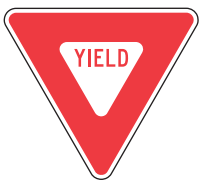
Yield the right-of-way if necessary.
Stop completely before proceeding.
Speed up to merge quickly.
Pedestrians must stop and wait.
A yield sign indicates that the road you are on merges with another. Drivers must slow down or stop if needed, giving right-of-way to vehicles, pedestrians, or bicycles on the other road to ensure safe merging.
What is the primary function of an acceleration lane?
Parking or emergency use only.
Slow down exiting vehicles.
Match highway speeds before merging.
Rest stop for drivers.
An acceleration lane lets drivers entering a highway increase speed to match existing traffic. This ensures a smooth, safe merge, reduces collision risk, and maintains consistent traffic flow on high-speed roads.
Recommended safety practice for pedestrians crossing streets:
Crossing diagonally.
Listening for vehicles.
Looking both ways.
Running across the street.
Pedestrians should look both ways before crossing to check for oncoming traffic from either direction. This ensures safe crossing by confirming the road is clear and reduces the risk of accidents 🚶♀️🚗.
Regarding traffic laws, what general rule applies to bicyclists?
Are exempt from traffic laws.
Same rights as vehicle drivers.
Only follow laws on main roads.
Must follow pedestrian laws.
Bicyclists share the same rights and responsibilities as vehicle drivers. They must obey all traffic laws, signals, and signs, ensuring safety for themselves and others on the road.
What is defensive driving?
Driving at or below the speed limit.
Avoiding dangerous, unexpected situations.
Obeying all traffic laws.
Maintaining a safe following distance.
Defensive driving means safeguarding yourself and others from dangerous or unexpected road situations. It involves anticipating potential hazards and using proactive strategies to avoid accidents, ensuring safer driving for everyone.