Learner Permit Test: 04 of 05
Free New Jersey Driving Practice Test 4
Prepare for your New Jersey MVC driving knowledge test (NJ permit written test) with multiple-choice practice questions covering traffic laws, road signs and safe driving rules.
STUDY TOPICS
Syllabus Covered
New Jersey Driver Manual.
TEST FORMAT
Question Pool
Multiple-choice practice questions.
YOUR GOAL
Target Pass Mark
Aim for 80% or Higher.
Before You Start the Test:
Read the official New Jersey Driver Manual at least twice, and make sure you know your road signs.
On public roads, a moped driver must:
Drive only on bike lanes.
Follow all traffic signs.
Use the sidewalk if empty.
Exceed 25 mph.
Moped drivers have the same rights and responsibilities as other motorists. They must follow all traffic laws, including signs, signals, and lane markings.
The Nonresident Violator Compact does NOT apply to:
Speeding.
Reckless driving.
Parking violations.
Running a red light.
The compact is only for moving violations. Since parking is a non-moving violation, it is not included.
What are acceleration lanes?
High-speed exit lanes.
Passing lanes on the left.
Extra lanes at entrances.
Lanes for fast vehicles only.
Acceleration lanes are extra lanes at highway entrances used by motorists to speed up and safely join the flow of traffic.
Children under age 2 (less than 30 lbs) must be in:
A rear-facing seat.
A forward-facing seat.
A booster seat.
The front seat.
Kids under 2 years and 30 lbs must use a rear-facing seat in the back. It is the safest way for their neck and spine.
What does this sign mean?
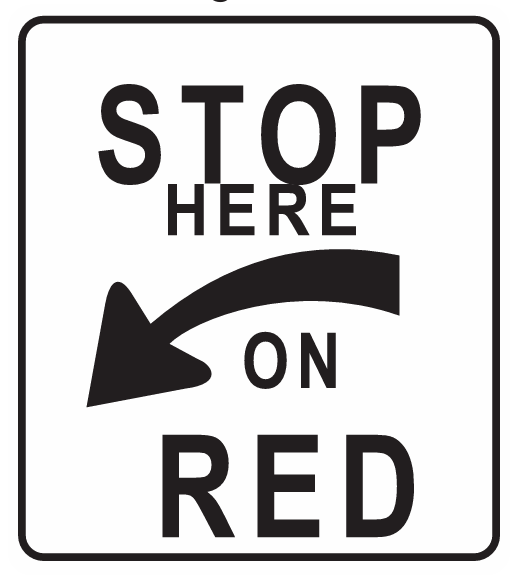
Stop only if turning right.
The precise location to stop.
Stop only if there is traffic.
Speed up on red.
This sign tells you the exact line where you must stop when the traffic light is red.
A single solid white line across an intersection means:
Stop behind the line.
No lane changing.
Crosswalk ahead.
The lane is ending.
This is a Stop Line. At an intersection, you must stop your vehicle behind this line for a red light or stop sign.
Which of these is NOT required for a Special Learner Permit:
Vision test.
Knowledge test.
Parental consent.
Road test.
The road test is only required for a Probationary License after completing at least six months of supervised driving with a permit.
Why keep your wrist down on motorcycle handgrips?
Prevent over-throttling.
Better grip on bumps.
Reduce hand fatigue.
Improve brake reach.
Keeping your wrist flat or slightly down helps you avoid accidental acceleration if you lose your balance or hit a bump.
A tired driver’s reaction time is comparable to:
A student driver.
A distracted driver.
A drunk driver.
A sobered driver.
Driving while tired is extremely dangerous. A tired driver has a slow reaction time and poor judgment, similar to someone driving under the influence of alcohol.
What does this sign indicate?

Divided highway begins.
Two-way traffic ahead.
Double lane highway.
Opposite traffic separated.
This sign warns that you are approaching a road where traffic moves in two opposite directions on the same roadway. It does not mean there are only two lanes or that the road is divided.
What does a hand and arm pointed upward mean?
Left turn.
Right turn.
Stop.
Slow down.
Hand and arm upward indicates a right turn. It’s like making an 'L' shape with your left arm.
Without a sidewalk, pedestrians and joggers should walk:
With the flow of traffic.
Facing oncoming traffic.
On the left shoulder only.
On the right shoulder only.
Walking facing traffic allows you to see approaching vehicles and gives both you and the driver more time to react.
Abandoning a vehicle on a highway is a violation after:
4 hours or more.
24 hours or more.
1 hour.
2 hours.
In NJ, leaving a vehicle on a highway for 4 hours or more is considered abandoning it and is a violation.
What is the shape of a YIELD sign?
Rectangle.
Pentagon.
Pennant.
Inverted triangle.
A yield sign is a three-sided, white inverted triangle with a red border, designed to be easily recognized even from the back.
What factor determines your BAC?
Drink mixer.
Time of day.
Fitness level.
Body weight.
BAC is determined by four factors: the amount of alcohol consumed, body weight, how quickly the drinks were consumed, and food eaten.
Mandatory insurance for every vehicle in New Jersey is:
Collision.
Liability.
Comprehensive.
Personal Injury.
New Jersey law requires every vehicle registered in the state to be covered by liability insurance for financial protection in case of accidents.
To avoid hydroplaning on wet roads, you should:
Drive on the highest point.
Drive on the shoulder.
Use the lowest gear.
Speed up to 55 mph.
To avoid hydroplaning, you should slow down and try to drive on the highest point of the road (usually the center lane).
What is the point value for tailgating?
5 points.
2 points.
3 points.
4 points.
Tailgating is considered a serious moving violation in NJ and results in 5 points being added to your driving record.
NJ law requires you to keep to the right except when:
Driving at night.
The road is wet.
Overtaking or passing.
Traffic is heavy.
You must stay in the right lane unless you are passing another vehicle or the right lane is closed.
What does this sign represent?

Maximum legal speed limit.
Recommended speed for the exit.
Minimum speed for the highway.
Suggested speed for heavy trucks.
This sign recommends a safe speed for an exit ramp or a curve. It is an advisory speed, not a mandatory limit.
GDL driving restricted hours for permit holders under 21 are:
Midnight to 5:00 AM.
10:00 PM to 6:00 AM.
11:01 PM to 5:00 AM.
No restrictions.
Drivers under age 21 with a GDL permit are prohibited from driving between 11:01 PM and 5:00 AM to reduce nighttime accidents.
Under Safe Passing Law, the required safety zone is:
2 feet.
6 feet.
4 feet.
8 feet.
The Safe Passing Law requires drivers to maintain a 4-foot safety zone when passing pedestrians, cyclists, or scootists.
In city driving, a motorist should look at least:
3 seconds ahead.
5 seconds ahead.
20 seconds ahead.
12 seconds ahead.
In city driving, you should look 12 seconds ahead. This is about one city block at 25 mph, giving you enough time to react to traffic or pedestrians.
Yellow center lines are used to:
Separate same-way traffic.
Mark the road shoulder.
Show where to stop.
Separate opposite traffic.
Yellow lines separate traffic moving in opposite directions. White lines are used to separate traffic moving in the same direction.
Total stopping distance at 60 mph is:
123 feet.
247 feet.
453 feet.
343 feet.
At 60 mph, the total distance to stop is 343 feet. This includes the time you take to react plus the actual braking distance.