Class E Knowledge Exam: 02 of 03
Free Florida Driving Practice Test 2
Prepare for your Florida Class E knowledge exam (FL driver license written test) with multiple-choice practice questions covering Traffic laws, Safe driving practices and Identifying traffic controls.
STUDY TOPICS
Syllabus Covered
Florida Driver License Handbook.
TEST FORMAT
Question Pool
Multiple-choice practice questions.
YOUR GOAL
Target Pass Mark
Aim for 80% or Higher.
Before You Start the Test:
Read the official Florida Driver License Handbook at least twice, and make sure you know your road signs.
What does the below signal indicate?

Lane closed, do not enter.
Lane signal about to turn red.
Lane open, proceed freely.
Lane signal about to turn green.
A yellow X warns that the lane will soon close (turn red). Drivers must safely exit the lane to avoid collisions and follow Florida lane signal regulations.
At an All-Way Stop, if vehicles arrive simultaneously, who goes first?
First vehicle to arrive.
Largest vehicle.
Driver who arrived last.
Driver on the right.
At an all-way stop, when multiple vehicles arrive together, the driver on the right has the right-of-way. This Florida rule prevents confusion and ensures orderly, safe movement through intersections.
When a CMV approaches from the opposite direction, you should:
Flash headlights.
Keep right in your lane.
Move left in your lane.
Speed up to pass.
When an oncoming commercial motor vehicle approaches, staying to the right side of your lane maintains safe separation. This helps prevent sideswipe collisions and ensures both vehicles can pass safely without encroaching on each other’s path.
What does a flashing yellow light indicate to drivers?
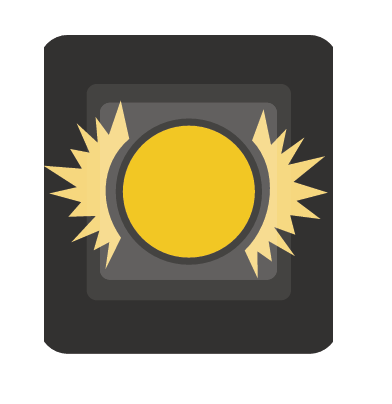
Stop completely before proceeding.
Proceed with caution.
Turn only when clear.
Yield only to pedestrians.
A flashing yellow light warns drivers of a potentially hazardous intersection, school zone, or sharp curve. It does not require stopping but signals to slow down and remain alert, following Florida traffic safety guidelines.
Under a red arrow signal, which movement is allowed?
Left turn if way is clear.
Left turn from one-way onto one-way.
Proceed straight if clear.
Right turn when not prohibited.
A red arrow prohibits the indicated movement until green. However, Florida law permits a left turn from a one-way street onto another one-way street after stopping and yielding to pedestrians and traffic, ensuring safe and legal maneuvering.
How far in advance must you signal before making a turn?
At least 50 feet.
At least 200 feet.
At least 100 feet.
At least 300 feet.
Florida law requires drivers to activate their turn signals at least 100 feet before turning. This provides other road users sufficient notice to react safely, helping prevent collisions and ensuring smooth traffic flow.
In which direction do vehicles travel in a roundabout?
Alternating flow.
Clockwise.
Counterclockwise.
Single direction.
Vehicles move counterclockwise in a roundabout. This design promotes continuous traffic flow, minimizes conflict points, and reduces the likelihood of collisions, ensuring safe and efficient navigation through the intersection.
Which part of a limited-access highway entrance helps adjust speed and merge safely?
Acceleration lane.
Entrance ramp.
Merging area.
Signal lane.
The merging area is the section where drivers match the highway traffic speed and safely blend into the flow. Proper use prevents collisions and allows smooth entry onto limited-access highways, as outlined in Florida driving regulations.
For a second DUI, how long must an Ignition Interlock Device be installed?
180 days.
One continuous year.
Five continuous months.
Two continuous years.
Florida law requires that after a second DUI conviction, an Ignition Interlock Device be installed in the offender’s vehicle for at least one continuous year. This helps prevent driving under the influence and promotes road safety.
What does restriction code 1 indicate on a Florida driver's license?
Business purposes only.
Daylight driving only.
Employment purposes only.
Other restrictions.
Florida restriction code 1 limits driving to essential activities for livelihood, such as work, school, church, and medical appointments. The driver cannot use the vehicle for general personal use, ensuring compliance with the license conditions.
How many braking systems must a vehicle have?
Four.
One.
Three.
Two.
Florida law requires vehicles to have two separate braking systems. This dual system ensures that if one fails, the other can still stop the vehicle safely, reducing the risk of accidents.
What color are regulatory traffic signs?
Green with black.
Orange with black.
White with black.
Yellow with black.
Regulatory signs that control traffic and set legal requirements are mainly white with black lettering or symbols. Drivers must follow these instructions such as speed limits, lane use, and parking rules.
What is the first step if your gas pedal gets stuck?
Lift your foot off.
Press brake hard.
Shift to neutral.
Turn engine off.
Removing your foot from the accelerator is the first action, because the pedal may release and speed can reduce naturally. Staying calm and avoiding sudden moves helps maintain control before taking further steps like shifting to neutral or braking safely.
Which statement best describes the safest driving speed?
Speed allowing full control.
Posted limit always.
Same as traffic.
10 MPH over limit.
The safest speed is one that matches road, traffic, and weather conditions, while keeping you in full control. Even if lower than the limit, you must drive at a speed that allows safe stopping and avoiding hazards as required by Florida law.
What does this sign signify?

Emergency vehicles crossing.
Slow vehicles crossing.
Large vehicles crossing.
Government vehicles crossing.
This sign warns that emergency vehicles may enter or cross the roadway. Drivers should slow down, stay alert, and yield as needed, ensuring safety and compliance with Florida traffic rules.
What is the fee for an original learner's license?
$25.00
$15.00
$6.25
$48.00
In Florida, obtaining an original learner’s license requires a fee of $48.00. This covers the cost of processing, testing, and issuing the learner’s permit in compliance with state regulations.
What specific check should be performed for brakes?
Check for squealing noises.
Check brake fluid level.
Pedal stays above the floor.
Ensure pedal feels firm.
When inspecting brakes, pressing the pedal should not make it touch the floor. This confirms proper brake function and responsiveness, ensuring safe stopping ability as required by Florida vehicle safety standards.
Which vision test result meets Florida requirements without referral?
20/50 or worse in either eye.
20/70 in either eye.
20/40 or better in one eye.
20/40 or better in each eye.
Florida requires drivers to have at least 20/40 vision in both eyes, with or without corrective lenses, to pass the vision test. This ensures safe driving without the need for an eye specialist referral.
Turn signals are required when:
Changing lanes or overtaking.
Making only right turns.
Only in emergencies.
Turning at intersections only.
Drivers must use turn signals when changing lanes or passing another vehicle to clearly communicate intentions. This reduces the risk of collisions and ensures other road users can anticipate your movements.
Penalty for leaving the scene causing serious bodily injury:
Misdemeanor offense.
1st degree felony.
3rd degree felony.
2nd degree felony.
In Florida, leaving the scene of a crash that causes serious bodily injury is classified as a second-degree felony. This carries severe legal consequences, including imprisonment and fines, to enforce accountability and protect victims.
What type of sign is this?
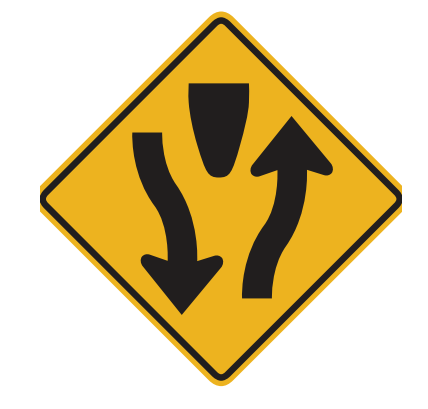
Regulatory sign.
Warning sign.
Information sign.
Guide sign.
This sign warns that the road ahead is divided by a median or barrier. Drivers should adjust speed and lane position to navigate safely, as required by Florida traffic rules.
What is overcorrection in vehicle control?
Sudden braking to avoid crash.
Maintaining constant speed.
Excessive steering after loss of control.
Steering too little around obstacle.
Overcorrection happens when a driver turns the wheel too sharply after the vehicle starts to drift. This strong reaction can cause skidding, rollovers, or the car entering oncoming traffic. Smooth, controlled steering keeps the vehicle stable and reduces crash risk.
Motorists should NOT share a lane with a motorcycle because:
Rider gets full lane.
Unstable in traffic.
Takes less space.
Too quiet to hear.
Motorcycles are allowed full use of a traffic lane for their safety and visibility. If a car shares the lane, the rider loses space to maneuver and crash risk increases. Florida law treats motorcycles as full-sized vehicles.
When registering a car in Florida, what proof of insurance is required?
$10,000 combined coverage.
Insurance from any state.
Liability insurance only.
Valid PIP and PDL insurance.
In Florida, when registering a car, you must provide proof of valid Personal Injury Protection (PIP) and Property Damage Liability (PDL) insurance. This coverage ensures that you meet the state's minimum insurance requirements for vehicle registration.
Which kind of sign is this?
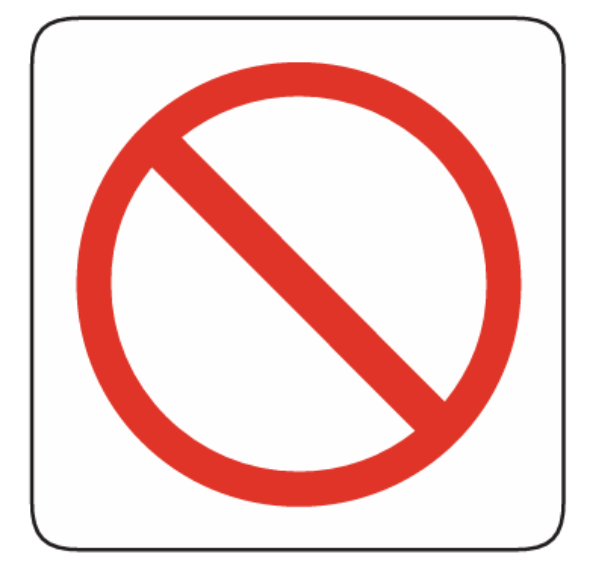
Guide sign.
Regulatory sign.
Warning sign.
Information sign.
A red circle with a red slash indicates prohibited actions. Regulatory signs tell drivers what they must or must not do, such as no U-turns or no parking, and are legally enforceable under Florida traffic laws.